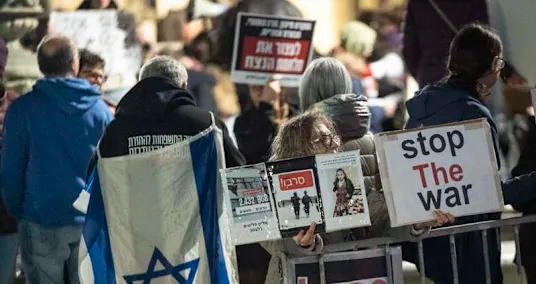
Demonstrators carried signs reading “We must stop” and “Bibi will kill us all,” while about 200 people gathered at Horev Junction in Haifa.
Anti-war demonstrations were held across Israel on Saturday evening, with protesters gathering in Tel Aviv, Haifa, Jerusalem, and Kfar Saba despite strict wartime restrictions on public assembly.
Demonstrators carried signs reading “We must stop” and “Bibi will kill us all,” while about 200 people gathered at Horev Junction in Haifa.
Earlier on Saturday, the Home Front Command granted an exceptional permit for a protest of up to 150 people at Habima Square in Tel Aviv, after state authorities told the High Court of Justice that demonstrations would be allowed only in a limited format and under tight attendance caps.
The Association for Civil Rights in Israel sought an urgent hearing, arguing that the restrictions harm the right to protest.

Security restrictions and court dispute
One IDF officer said the Home Front Command examined each requested protest site individually on operational, professional, and security grounds, including proximity to protected spaces. As a result, authorities did not approve a large gathering at Habima Square and instead allowed only 50 to 150 participants near a shelter.
The officer said the military declined to provide further details on all of its security considerations, but offered to present them to the court in a closed session.
“We are acting professionally and objectively. There is no political consideration here or any other consideration,” he said.
The requests covered several locations, including Habima Square in Tel Aviv, Horev Center in Haifa, Paris Square in Jerusalem, and Weizmann Street in Kfar Saba. In Tel Aviv, the state told the Supreme Court that the protest could proceed in two separate groups of up to 75 people each, for a total of 150 participants.
Protest groups push back
Police and the Home Front Command said the limits stemmed from operational and security concerns, against the backdrop of fears of missile fire and broader wartime restrictions on gatherings.
Civil rights lawyers, however, argued in court that earlier judicial remarks on the importance of political free expression during wartime had not been meaningfully implemented.
The dispute followed a tense High Court hearing on Friday, during which Supreme Court President Isaac Amit sharply criticized the state’s position.
The judges stressed that the right to protest does not disappear during war and said police should propose a framework that would allow demonstrations to proceed.
LATEST POSTS
- 1
 Trouvez La Carte De Cr\u00e9dit Id\u00e9ale Pour Vos Besoins En Belgique
 - 25 Home Improvement Styles: Decision in favor of Your #1
- 3Astrophotographer captures rare footage of the Hubble Telescope crossing the sun (video)
- 4Living Abroad: Social Inundation and Self-improvement
- 5South Carolina measles outbreak grows by nearly 100, spreads to North Carolina and Ohio


- Dave Coulier shares new cancer diagnosis 1 year after revealing previous diagnosis
- Kidneys from Black donors are more likely to be thrown away − a bioethicist explains why
- JFK's granddaughter reveals terminal cancer diagnosis, criticizes cousin RFK Jr.
- A Sweet Choice: Pick Your #1 Cake!
- Dutch police probe a small blast outside a pro-Israel Christian center
- Trial of pro-Palestine activist begins
- Medical team successfully delivers baby and removes massive tumor
- Tech Patterns: Contraptions That Will Shape What's in store
- Scientists dove hundreds of feet into the ocean and found creatures no human has ever seen. Our trash beat us there


